What Exactly Is MAS?
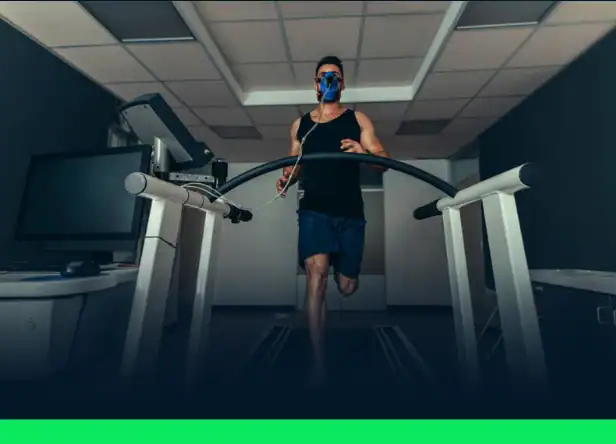
Maximal Aerobic Speed (MAS) represents the running speed at which players consume the maximum amount of oxygen their bodies can use.
Before reaching MAS, oxygen consumption increases alongside exercise intensity. Most of the body’s energy at this stage is provided by the aerobic system.
Unlike maximal sprinting speed, which can only be sustained for seconds, MAS can typically be maintained for 4 to 8 minutes depending on the player’s conditioning level. This distinction is crucial for understanding the physiological demands of modern soccer.
When MAS is exceeded, the body cannot consume more oxygen. At that point, the extra power is delivered through the anaerobic lactic system.
What’s the Link Between MAS and VO₂ Max?
The relationship between MAS and VO₂ Max forms the cornerstone of aerobic assessment in soccer. MAS serves as the “velocity at VO₂ Max” (vVO₂ Max), representing the lowest speed at which maximum oxygen uptake occurs. Research demonstrates that elite soccer players typically exhibit VO₂ Max values ranging from 55-70 ml/kg/min, with positional variations where midfielders demonstrate significantly higher aerobic capacity compared to central defenders.
How Does the Human Body Work at Maximal Aerobic Speed?: Physiological Mechanisms at MAS
When soccer players operate at their Maximal Aerobic Speed, their cardiovascular and metabolic systems reach peak efficiency. Oxygen consumption and heart rate increase proportionally with running intensity until reaching MAS, at which point the curve plateaus. This plateau signifies that any additional power output beyond MAS must be supplied through anaerobic glycolytic pathways, resulting in significant lactate accumulation.
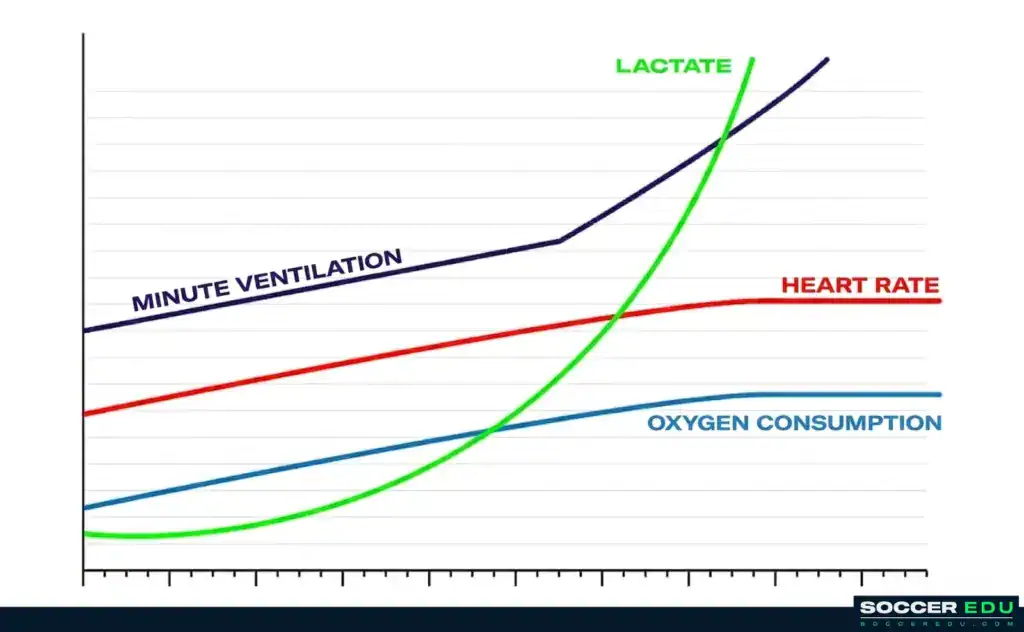
The aerobic system provides energy through efficient glycolysis with oxygen present, producing minimal lactate that can be rapidly recycled. However, when exercise intensity exceeds MAS, the body shifts to anaerobic metabolism, generating substantial lactic acid that accumulates faster than the body can clear it. This metabolic transition explains why training at specific percentages of MAS proves so effective for developing different energy systems.
Our body, through the muscles, generates energy via a process called glycolysis: stored muscle sugar (glycogen) is broken down to produce energy.
This process can occur in two ways:
- With oxygen (aerobic metabolism): slower but more economical, producing little lactate that is quickly recycled.
- Without oxygen (anaerobic metabolism): faster but results in significant lactic acid production.
Aerobic metabolism is the most efficient way to generate energy, but it’s limited in power output. That’s why light jogging mainly relies on this pathway, with almost no lactate buildup.
During sprints or sharp accelerations, however, the body relies heavily on the anaerobic system, which produces large amounts of lactate that accumulate faster than the body can recycle them.
MAS Characteristics in Soccer Players
Professional soccer players typically demonstrate MAS values between 8 km/h and 24 km/h, with elite players clustering toward the higher end of this spectrum. This wide range reflects the diverse physical demands across playing positions and competitive levels. Modern soccer’s increasing physicality has elevated the importance of aerobic conditioning, with players now covering approximately 37% more distance than just six years ago.

Positional demands significantly influence MAS requirements. Midfielders and full-backs require exceptional aerobic capacity due to their constant transitions between defensive sprints and offensive overlapping runs. These players must maintain high-intensity efforts throughout the match while contributing to both pressing phases and creative build-up play.
The correlation between MAS and match performance is well-established in research. Studies demonstrate that players with higher aerobic capacity cover greater distances during matches, complete more sprints, and maintain technical proficiency for the full 90 minutes. When youth players improved their VO₂ Max by 11% over eight weeks, they demonstrated a 20% increase in total distance covered, 23% more ball involvements, and doubled their sprint frequency during competitive matches.
How to Calculate MAS? Comprehensive MAS Testing Protocols
At the start of the season, before physical preparation begins, it’s essential to conduct an initial MAS test to evaluate each player’s fitness level.
Over the years, coaches and sports scientists have developed a variety of MAS tests. They can be grouped into several types:
- Continuous tests: Cooper test, half-Cooper test
- Intermittent tests: with recovery periods
- Rectangular tests: constant running speed
- Triangular tests: speed increases progressively in stages
- Straight-line tests
- Shuttle tests: involve frequent changes of direction
Unlike running, soccer does not involve continuous efforts. Instead, it alternates sprints and short recovery periods, with frequent rhythm and direction changes.
Referees are also concerned with MAS, as they must regularly train to pass the TAISA test, required for officiating.
The Simplest: The Cooper Test
The Cooper Test remains the most accessible MAS assessment for soccer teams. This straightforward protocol requires players to run continuously for six minutes while measuring total distance covered. The simplicity of implementation makes it ideal for teams with limited resources or large squad sizes.
Protocol Exécution:
- Position distance markers every 10 meters around the training pitch
- Utilize mechanical odometers for enhanced accuracy
- Players run continuously for exactly six minutes
- Record precise distance covered when the whistle signals completion
- Prepare data collection sheets with player numbers for efficient lap counting
The conversion from distance to MAS follows established formulas. For example, a player covering 1600 meters achieves a MAS of 13.7 km/h, while 2000 meters corresponds to 17.1 km/h. This linear relationship enables coaches to quickly assess and compare player fitness levels across the squad. Check the below table for reference:
Reference Table – Distance vs. MAS
| Distance in 6 min | MAS (km/h) |
|---|---|
| 800 m | 6.9 km/h |
| 1000 m | 8.6 km/h |
| 1200 m | 10.3 km/h |
| 1400 m | 12 km/h |
| 1600 m | 13.7 km/h |
| 1800 m | 15.4 km/h |
| 2000 m | 17.1 km/h |
| 2400 m | 20.6 km/h |
| 2800 m | 24 km/h |
The 30-15 Intermittent Test
Martin Buchheit’s 30-15 Intermittent Fitness Test provides a more soccer-specific assessment that better reflects the sport’s intermittent nature. Buchheit, a renowned sports scientist and former PSG performance coach, designed this test to measure multiple physical qualities simultaneously.
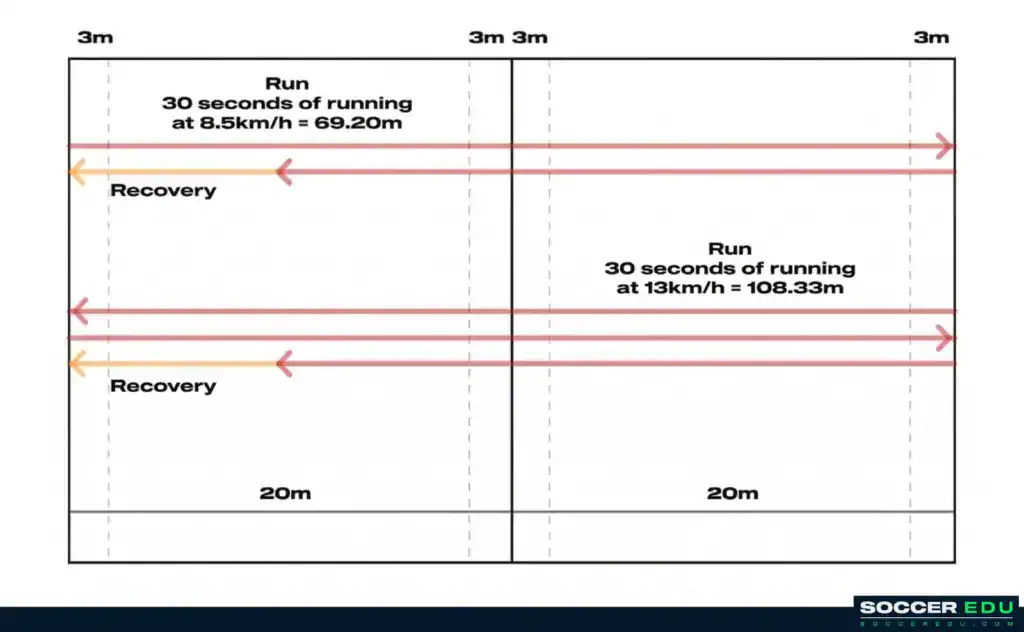
The 30-15 IFT addresses the limitation of continuous tests by incorporating the change of direction demands and recovery patterns characteristic of soccer. This intermittent triangular test evaluates maximal aerobic power, anaerobic speed reserve, inter-effort recovery capacity, and neuromuscular qualities through repeated accelerations after directional changes.
Protocol:
- Players alternate 30 seconds of running with 15 seconds of walking.
- The setup:
- Three lines (A, B, C) placed 20m apart.
- Four tolerance lines (red dotted lines), 3m from each side of A, B, and C.
- Players run according to audio signals.
- At the end of each stage, they have 15 seconds to walk to the next line.
- The test starts at 8 km/h (fast walking pace) and increases by 0.5 km/h per stage.
- The test ends when a player fails to reach the tolerance zone three consecutive times.
- The coach records the last validated stage, not the stage where the player stopped.
Research demonstrates that the 30-15 IFT provides superior training prescription compared to continuous tests. Using the final intermittent fitness test velocity (VIFT) results in more homogeneous cardiorespiratory responses during high-intensity interval training, as VIFT incorporates aerobic power, anaerobic speed reserve, recovery capacity, and change of direction abilities.
Advanced MAS Training Methodologies
High-Intensity Interval Training (HIIT) Prescription
Modern soccer conditioning emphasizes time spent at or above 100% MAS as the critical factor for improving aerobic power. Research indicates that performing multiple short intervals above MAS proves more effective than traditional long slow distance training or single continuous efforts at MAS.
Optimal training intensities center around 120% MAS for short intervals followed by equal passive recovery periods. This intensity allows for the greatest supra-maximal training stimulus when maintained for 15-30 seconds with matching rest intervals, continuing for 5-10 minutes total duration.
The renowned “Tabata method” demonstrates the effectiveness of high-intensity intermittent training. Players working at 170% VO₂ Max for 20 seconds followed by 10 seconds passive recovery, repeated for 4 minutes, showed superior improvements in both aerobic and anaerobic power compared to 60-minute low-intensity sessions. The high-intensity group improved anaerobic performance by 28% while the low-intensity group showed no change.
Periodized MAS Development
Seasonal MAS progression requires systematic planning with 3-4 assessment periods throughout the year. As players adapt to training stimuli, their MAS naturally improves, necessitating progressive overload to continue development. Without regular reassessment and training adjustment, sessions become insufficient to stimulate further adaptation.
Pre-season conditioning represents the most intensive MAS development phase. Elite clubs like Real Madrid implement demanding aerobic training protocols during this period, understanding that superior physical condition enables players to maintain technical sharpness throughout entire matches. As soccer legend Zinedine Zidane emphasized, “Good physical condition allows a player to remain technically sharp for the full 90 minutes”.
Training zone prescription based on MAS percentages enables precise physiological targeting:
- Zone 1 (Recovery): 65-84% of lactate threshold, promoting active recovery
- Zone 2 (Endurance): 85-91% of lactate threshold, building aerobic base
- Zone 3 (Lactate Threshold): 92-95% of lactate threshold, improving anaerobic threshold
- Zone 4 (VO₂ Max Intervals): 95-100% of lactate threshold, maximizing aerobic power
- Zone 5 (Neuromuscular Power): Above lactate threshold, developing anaerobic capacity
Practical Implementation Strategies
Team-Based Training Organization
Squad differentiation becomes essential when implementing MAS-based training with varying fitness levels. Coaches should group players according to their assessed MAS values, enabling appropriate intensity prescription for each fitness bracket. For example, players with MAS between 4.6-4.8 m/s train together using their group-specific percentages, while those with MAS between 4.2-4.4 m/s follow adjusted protocols.
Training periodization must account for match demands and recovery requirements. The high-intensity nature of MAS training necessitates careful scheduling to avoid overload while maximizing adaptation. Professional teams typically incorporate 2-3 dedicated MAS sessions per week during pre-season, reducing to 1-2 maintenance sessions during competitive periods.
Technology Integration
GPS monitoring systems enable precise tracking of MAS training loads during sessions. Modern player monitoring combines heart rate data with positional tracking to ensure players achieve target intensities while managing fatigue accumulation. This technology allows coaches to individualize training loads based on each player’s unique physiological profile.
Heart rate variability assessment provides additional insight into training adaptation and recovery status. The 5-5 running test developed by Martin Buchheit utilizes HRV monitoring to assess training status, complementing traditional MAS assessments for comprehensive fitness evaluation.
Advanced Applications and Future Considerations
Anaerobic Speed Reserve (ASR)
The relationship between MAS and maximal sprint speed creates the Anaerobic Speed Reserve, representing the difference between these two velocities. ASR provides valuable insight into a player’s capacity for supra-maximal efforts and helps optimize training prescription for different playing positions.
Players with higher ASR typically possess greater explosive capability and may require different training emphases compared to those with lower ASR values. This metric enables coaches to better understand individual player profiles and tailor conditioning programs accordingly.
Recovery and Adaptation Monitoring
Lactate threshold assessment remains valuable for monitoring training adaptations throughout the season. Research demonstrates that lactate threshold improves more readily than VO₂ Max in response to soccer training, making it a sensitive indicator of conditioning status.
Progressive overload principles apply directly to MAS training. Players demonstrating improved MAS values require corresponding increases in training intensities to continue adaptation. Regular reassessment ensures training remains appropriately challenging while preventing stagnation.
The integration of MAS assessment and training prescription represents a fundamental shift toward evidence-based soccer conditioning. This systematic approach enables coaches to move beyond intuitive training methods, providing precise physiological targets that optimize player development while minimizing injury risk through appropriate load management.
Evolving physical demands of the current soccer scenario require sophisticated conditioning approaches that address the sport’s intermittent, high-intensity nature. MAS-based training methodologies provide the scientific foundation necessary to develop players capable of maintaining technical excellence under the increasing physical pressures of contemporary soccer competition.