A soccer match demands speed, power, and the ability to repeat high-intensity efforts throughout 90 minutes of play. Behind this endurance lies a key indicator: VO2 max, which refers to the maximum amount of oxygen a player can use during intense activity.
Well known to strength coaches and trainers, this metric helps evaluate a player’s aerobic potential and guide endurance training. Understanding VO2 max in soccer, knowing how to measure it, and implementing strategies to improve it are essential tools for optimizing match performance and recovery.
What Is VO2 Max in Soccer?
VO2 max (Maximum Oxygen Uptake) refers to the amount of oxygen the body can consume and use per minute per kilogram of body weight during maximal exercise. The higher the value, the longer a player can sustain intense efforts and maintain technical proficiency under physical stress.
Soccer alternates between phases of high-intensity running and calmer moments. A player with a strong VO2 max can repeat explosive efforts more effectively, recover faster between high-intensity actions, and maintain technical efficiency and decision-making quality even during the closing stages of a match.
Research indicates that elite male soccer players typically possess VO2 max values ranging between 55-70 ml/kg/min, with professional players generally displaying higher values than amateur counterparts. Elite female players demonstrate values between 54-63 ml/kg/min across different positions.
Why Is VO2 Max Important in Soccer?
Beyond its scientific definition, VO2 max directly impacts how effective a player can be in a game. It determines their capacity to repeat efforts, stay mentally sharp under fatigue, and meet the specific physical demands of their positional role.
Direct impact on Match performance
Endurance in soccer is fundamentally about repeating short, intense actions throughout 90 minutes. A high VO2 max helps resist fatigue accumulation, sustain higher work rates during crucial match moments, and remain decisive until the final whistle. Studies show that players with superior aerobic capacity cover more ground during matches, complete significantly more sprints, and maintain higher technical performance levels in the final third of games.
Preventing loss of Technical Quality
As fatigue sets in during the latter stages of matches, technical proficiency and decision-making capabilities typically decline. Players with strong aerobic conditioning maintain clarity and precision even in the closing minutes, when matches are often decided. Research demonstrates that players with higher VO2 max values less deterioration in passing accuracy and ball control during the final 15 minutes of play.
Position-specific Demands and Requirements
Central midfielders, who cover the most distance during matches (often 11-12km), benefit most from high VO2 max values, with elite players showing 54.7-63 ml/kg/min. Defenders typically demonstrate values of 53.2-62.8 ml/kg/min, while forwards register 54.5-62.9 ml/kg/min. In contrast, goalkeepers show the lowest values (48.4-57.5 ml/kg/min) due to their specialized role requiring explosive power rather than sustained aerobic work.
Female players display similar positional patterns: midfielders (63.24 ± 7.04 ml/kg/min), forwards (58.92 ± 7.70 ml/kg/min), and defenders (55.73 ± 4.40 ml/kg/min).
How to Measure VO2 Max in Soccer
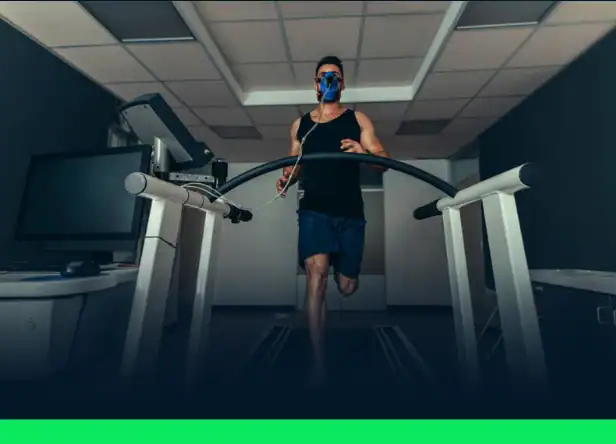
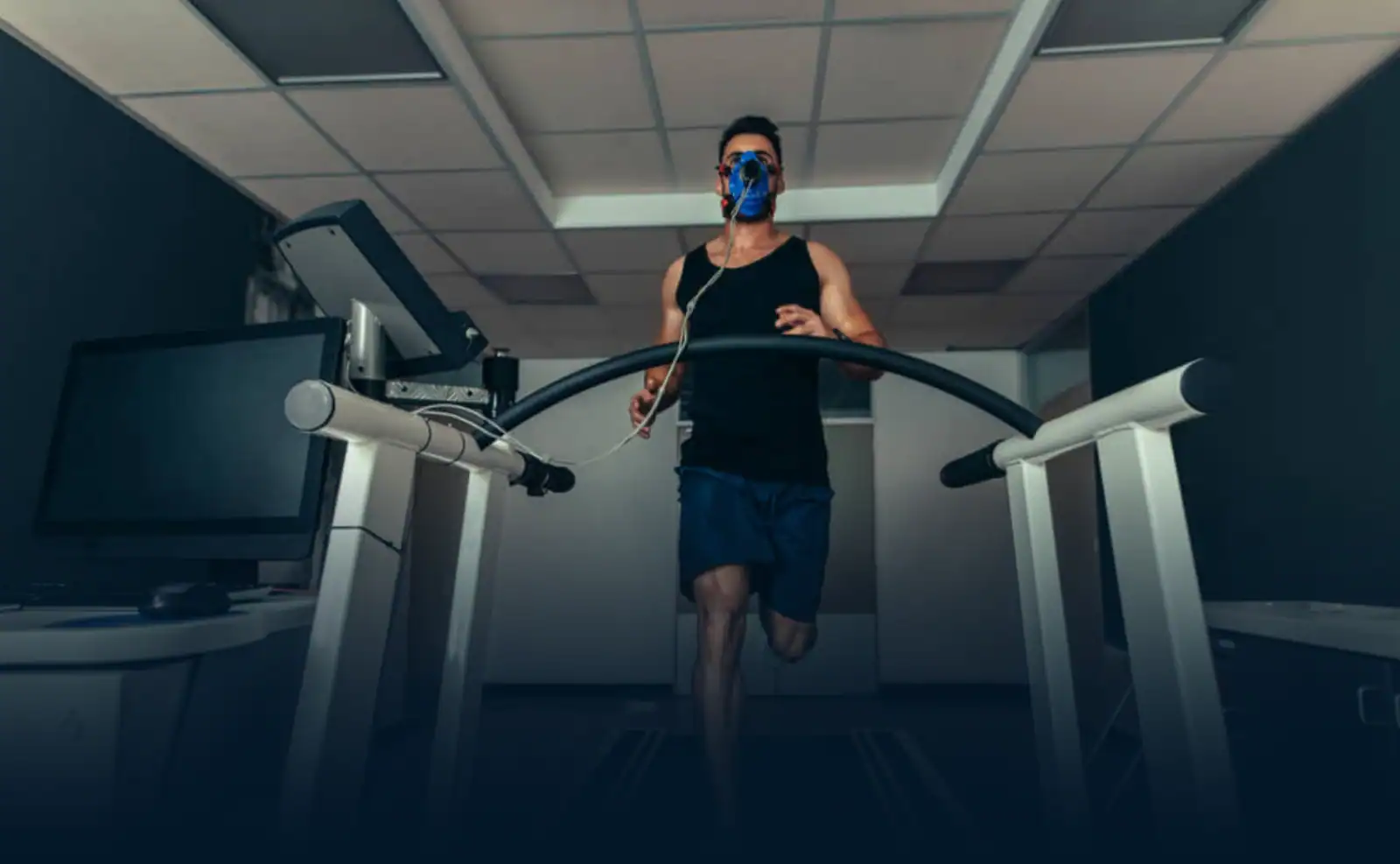
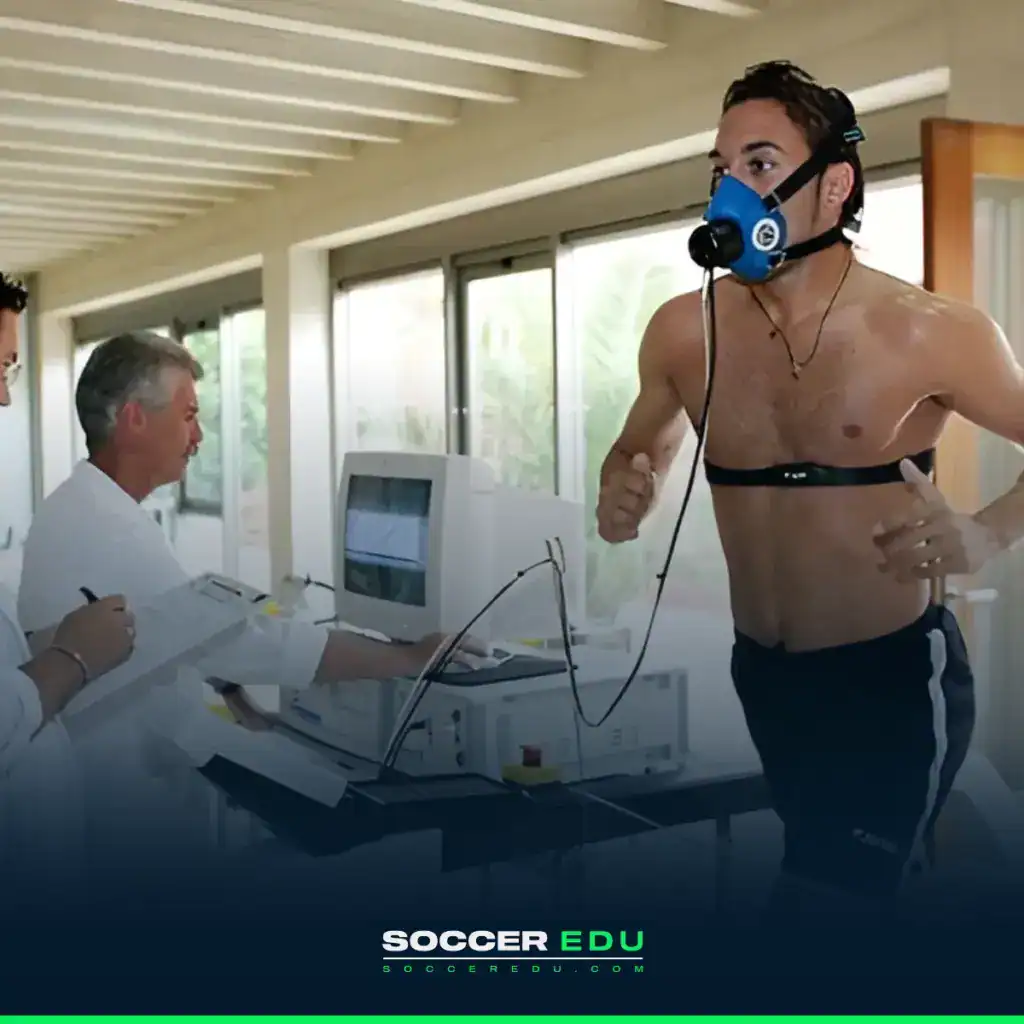
Direct VO2 max testing requires lab equipment (mask, gas exchange analysis). However, in both grassroots and elite soccer, field tests provide reliable estimates that are more practical for regular monitoring:
VAMEVAL test
Players run around a track following audio signals that progressively increase speed until exhaustion. The final speed achieved provides an accurate estimate of VO2 max and Maximum Aerobic Speed (MAS). This test is particularly valuable for determining individual training zones.
Cooper test
Players run as far as possible in 12 minutes. The distance covered correlates with VO2 max values using established formulas. While simple to administer, it’s less soccer-specific than other testing protocols.
Yo-Yo Intermittent Recovery Test
Widely adopted in professional soccer, this test involves alternating 20-meter shuttle runs with brief recovery phases. It closely replicates match demands by incorporating the stop-start nature of soccer and provides highly accurate endurance estimates that correlate strongly with match performance indicators.
Elite soccer clubs increasingly utilize multi-day testing approaches, integrating assessments into regular training microcycles rather than dedicating single “testing days”.
How to Improve VO2 Max in Soccer
VO2 max doesn’t improve through steady-state jogging alone but requires structured, repeated high-intensity efforts that challenge the aerobic system. Several evidence-based methods can be integrated into training—both with and without the ball—to effectively stimulate aerobic adaptations.
Aerobic High-Intensity Interval Training
Aerobic interval sessions remain the gold standard for VO2 max development. Research supports training at 85-95% of maximum heart rate in 3-8 minute intervals. Effective protocols include: 4-minute runs at ~90% of MAS with 2-3 minutes recovery, repeated 4-6 times, or 6x800m runs at VO2 max pace with 3-minute recoveries. These sessions are physiologically demanding but highly effective for aerobic adaptation.
Small-sided games at high intensity
Formats like 4v4 or 5v5 on reduced pitch sizes (30x20m to 40x30m) force continuous movement, repeated accelerations, and sustained high intensity. The advantage lies in combining physical conditioning with technical skill development and tactical decision-making, making training more soccer-specific and engaging for players.
Research indicates that SSGs with fewer players per team and smaller pitch dimensions elicit higher cardiovascular responses, approaching 85-95% of maximum heart rate.
Intermittent Running Protocols
Specific formats such as 15-second high-intensity runs followed by 15-second recovery periods, repeated for 12-15 minutes, closely mirror real match demands. Alternative protocols include 30:30 intervals (30 seconds at 100-110% MAS, 30 seconds recovery) for 10-20 minutes. These protocols improve both VO2 max and the capacity to repeat explosive efforts—a crucial requirement in modern soccer.
VO2 Max and MAS (Max Aerobic Speed)
VO2 max is directly linked to MAS—the minimum running speed at which a player reaches their maximum oxygen consumption. Understanding this relationship allows coaches to prescribe training intensities more precisely and monitor adaptations throughout the season. MAS typically ranges from 16-20 km/h in elite players, forming the foundation for interval training prescription.
Applying VO2 Max Work in Soccer Conditioning
Periodization is crucial when integrating VO2 max training throughout the competitive calendar. The approach must adapt to different phases while considering fixture congestion and recovery demands.
Pre-Season: Building the Aerobic Base
The pre-season period provides the optimal window for developing aerobic capacity through dedicated aerobic base building. Extended interval sessions (3-5 times weekly) combined with high-intensity small-sided games establish the aerobic foundation that will support players through the demanding match schedule ahead. This 4-8 week period allows for significant VO2 max improvements of 8-15%.
In-Season: Strategic Maintenance Through Microcycle Planning
Once competitive fixtures begin, the objective shifts from development to maintenance using structured weekly microcycles. Modern soccer employs match day-centered planning:
- MD+1: Active recovery for starters; moderate-intensity aerobic work for non-starters
- MD-4: Peak physical load day with high-intensity intervals or demanding SSGs
- MD-3: Moderate-intensity tactical work with aerobic maintenance
- MD-2: Low-intensity technical work with brief high-intensity bursts
- MD-1: Activation session with short, sharp efforts
This approach ensures VO2 max maintenance while managing fatigue accumulation and optimizing match-day performance.
During Fixture Congestion: Emphasizing Integration
When matches occur every 3-4 days, VO2 max maintenance must focus on integrated, soccer-specific formats. Combined training sessions that merge objectives from multiple traditional microcycle days become essential. Short SSGs (4v4 for 6-8 minutes) and brief interval runs with the ball provide necessary stimulus while minimizing additional physical stress.
Advanced Training Methodologies for VO2 Max Development
Position-Specific Aerobic Conditioning
Training must reflect the unique demands of each playing position. Midfielders require sustained high-intensity running capacity, benefiting from longer intervals (6-8 minutes at 85% MAS). Defenders need explosive recovery between high-intensity actions, making shorter intervals (2-3 minutes at 90-95% MAS) more appropriate. Forwards require repeated sprint capacity with aerobic recovery, utilizing formats like 6×30-second efforts with 90-second recoveries.
Integrated Technical-Physical Development
Modern soccer conditioning integrates ball work into aerobic development. Technical circuits combining passing, dribbling, and shooting at high intensity (heart rates >85% maximum) simultaneously develop VO2 max and soccer skills. Example: 4-station circuit including cone weaving with ball, shooting from distance, passing combinations, and heading practice, each performed for 90 seconds with 30-second transitions.
Practical Tips for Coaches and Players on VO2 Max in Soccer
Developing VO2 max requires systematic planning and adherence to scientific principles while respecting individual player needs.
Prioritize Intensity Over Volume
Extended, monotonous running sessions are less effective than shorter, well-structured intervals. Research demonstrates that training intensity—not duration—drives VO2 max adaptations. Three high-quality interval sessions weekly produce superior improvements compared to daily moderate-intensity running. Sessions should target 85-95% of maximum heart rate to stimulate optimal adaptations.
Utilize Heart Rate Monitoring for Precision
Modern technology enables precise intensity prescription through heart rate monitoring. Individual training zones based on tested MAS or age-predicted maximum heart rate ensure optimal stimulus. Players should maintain target heart rates during work intervals while achieving sufficient recovery (60-70% maximum heart rate) during rest periods.
Integrate the Ball for Enhanced Engagement
Soccer-specific endurance training should maintain relevance to match demands while maximizing player motivation. Ball-based conditioning achieves physiological adaptations while developing technical skills under fatigue—a crucial match requirement. Players demonstrate higher motivation and adherence when training incorporates soccer elements rather than generic running.
Monitor Recovery Systematically
VO2 max sessions impose significant physiological stress requiring structured recovery protocols. High-intensity days should be followed by appropriate recovery strategies: active recovery sessions at 60-70% maximum heart rate, structured mobility work, or reduced training loads the following day. Sleep quality, nutrition, and hydration status significantly impact adaptation and should be monitored consistently.
Individualize based on Player Profiles
Training cannot follow a one-size-fits-all approach due to significant individual variations in aerobic capacity, training history, and positional demands. Current fitness level, chronological age, playing position, injury history, and genetic factors must guide exercise selection and intensity prescription. Regular testing enables coaches to track individual progress and adjust training loads accordingly.
VO2 Max in Return-to-Play and Injury Prevention
Following injury, VO2 max becomes a critical indicator of readiness to return to competitive soccer. Aerobic deconditioning occurs rapidly during injury layoffs, with significant decreases observable within 2-3 weeks of reduced training. Systematic aerobic reconditioning ensures the cardiovascular system can sustain prolonged efforts and repeated high-intensity actions before returning to match intensity.
Return-to-play protocols should include progressive aerobic loading: beginning with continuous moderate-intensity running (60-70% MAS), advancing to intermittent work (75-85% MAS), and culminating in match-simulation exercises before full training integration. Players with superior VO2 max demonstrate reduced injury rates and faster recovery between training sessions.
Monitoring and Assessment Tools
Technology Integration
Elite soccer increasingly employs wearable technology to monitor VO2 max-related metrics during training and matches. GPS systems track high-intensity running distance, acceleration/deceleration patterns, and metabolic power output. Heart rate monitoring provides real-time intensity feedback, enabling coaches to adjust session demands dynamically.
Practical Field Tests
Beyond traditional VO2 max testing, practical field assessments provide valuable information for training prescription. The 30-15 Intermittent Fitness Test offers a soccer-specific alternative, providing both VO2 max estimation and intermittent running capacity assessment. Time trials over 1000-3000m distances provide simple yet effective monitoring tools for aerobic development.
VO2 Max in Soccer: Key Takeaways
VO2 max represents an essential physiological indicator for developing endurance capacity, recovery efficiency, and tactical effectiveness in soccer. Systematic measurement and targeted training provide coaches with evidence-based tools to design intelligent, individualized physical preparation programmes that enhance both performance and injury resilience.
For players, improving VO2 max translates to enhanced stamina throughout the full 90 minutes, accelerated recovery between high-intensity efforts, maintained cognitive sharpness during crucial match moments, and superior technical execution under fatigue conditions. In modern soccer, where matches are increasingly decided by fine margins and late goals are commonplace, superior aerobic conditioning often provides the competitive edge that separates successful players from their peers.
The integration of VO2 max training into comprehensive player development programmes, utilizing position-specific approaches, innovative training methods, and systematic monitoring, ensures that players can meet the ever-increasing physical demands of contemporary soccer while maintaining the technical and tactical excellence required for success at the highest level.