
In the modern game, talent alone rarely wins championships. While individual brilliance can turn a match, it is the tactical framework—the formation—that provides the platform for that brilliance to shine. For coaches, players, and even parents trying to make sense of the chaos on the field, understanding formations in soccer is the first step toward mastering the game.
Whether you are looking to organize a chaotic youth team or refine the tactical nuance of a varsity squad, this guide will serve as your comprehensive resource. We will break down what formations are, why they are vital to team success, and how to navigate the complex debate of “what is the best formation in soccer.”
What is a Soccer Formation?
At its simplest, a soccer formation is the structure a team adopts when they line up on the field. It is the designated arrangement of players into defenders, midfielders, and forwards.
Formations are typically described using a series of numbers, starting from the defense and moving forward (e.g., 4-4-2 or 4-3-3).
“Tactics determine where the ball has to go. Soccer determines where it actually goes.” – Johan Cruyff
- The Goalkeeper: The goalkeeper is never included in the number sequence because their position is constant.
- The Defenders: The first number represents the players on the back line.
- The Midfielders: The middle number(s) represent the players in the center of the park.
- The Forwards: The final number represents the attacking players.
While these numbers provide a starting structure, they are not static. A soccer tactical formation is fluid; a 4-3-3 in possession might morph into a 4-5-1 when defending. The formation essentially serves as a “home base” for players—a reference point for where they should be when the team is organized.
Why Do Formations Matter?
If players just ran wherever they wanted, the game would devolve into “bunch ball”—a common sight on U6 fields but a disaster for competitive play. Formations provide three critical benefits:
- Structure and Organization: They give players defined areas of responsibility, ensuring the field is covered efficiently.
- Player Roles: A formation dictates the job description. A wide midfielder in a 4-4-2 plays very differently than a winger in a 4-3-3.
- Tactical Identity: The formation signals intent. A 5-4-1 suggests a team plans to defend and counter, while a 4-3-3 often signals a desire to control possession and attack.
How to Choose a Formation
One of the most common questions coaches ask is, “How do I choose the right formation?” There is no multiple-choice answer. The “right” choice depends on several dynamic variables.
1. The Players at Your Disposal
This is the golden rule: Fit the system to the players, not the players to the system.
If you have two world-class strikers, playing a 4-3-3 (which typically uses only one central striker) might waste your best talent. A 4-4-2 or 3-5-2 would allow both to play centrally. Conversely, if your team lacks natural wingers, forcing a wide formation will lead to frustration.
2. The Opponent
Tactics are often reactive. If an opponent is dominating the midfield with three central players, playing a formation with only two central midfielders (like a flat 4-4-2) is a recipe for being overrun. Coaches often shift formations to create “numerical superiority” (having more players than the opponent) in key areas of the field.
3. The Objective of the Match
Are you the underdog trying to scrape a draw against a league leader? You might choose a defensive, compact formation. Do you need a win to secure a title? An aggressive, forward-thinking formation is likely required.
The Most Common Formations in Soccer
While there are dozens of variations, a few formations have stood the test of time or risen to dominate the modern era. Below is a brief overview of the most essential setups.
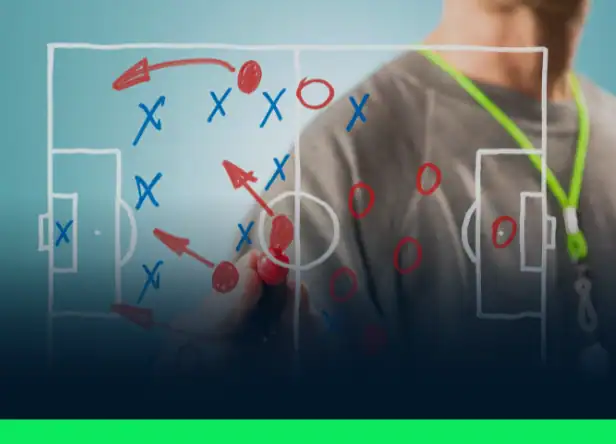
(Picture – a tactical board showing a soccer field with a formation diagram using magnetic tokens)
The 4-4-2: The Classic Standard
For decades, the 4-4-2 was the default setting for world soccer. It features four defenders, four midfielders, and two strikers.
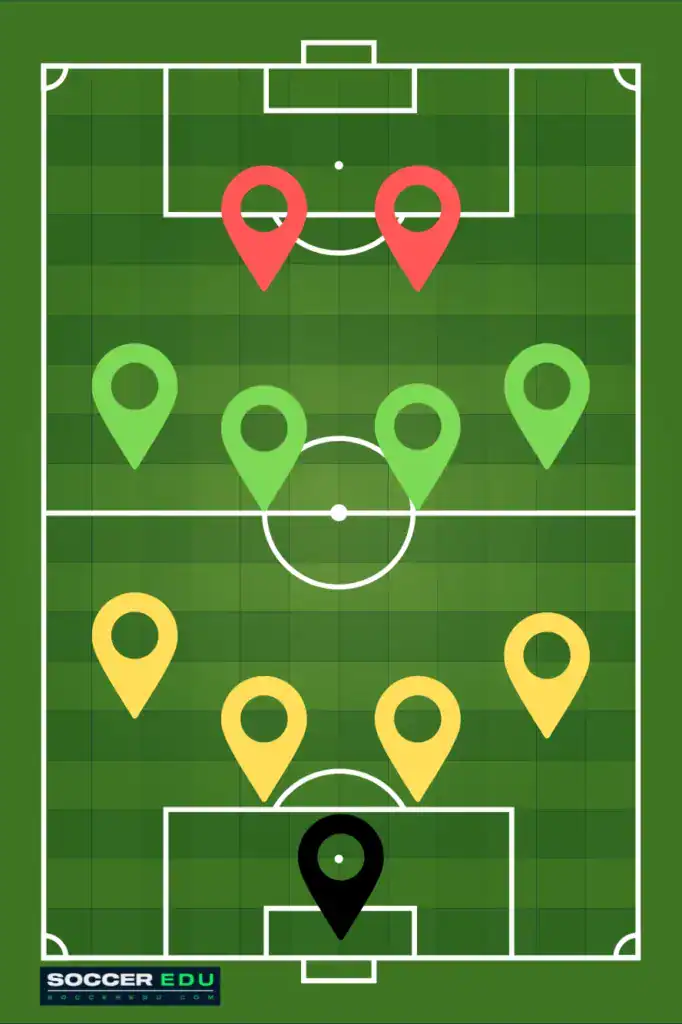
- Why use it? It is balanced and easy to understand. It provides excellent coverage of the width of the field and ensures there are always two players ready to attack the box.
- Potential Downside: It can leave you outnumbered in the central midfield against teams playing three players in the middle.
The 4-3-3: The Modern Favorite
Currently the formation of choice for many top-tier European clubs, the 4-3-3 utilizes a back four, a midfield trio (often a triangle), and three forwards (two wingers and a central striker).
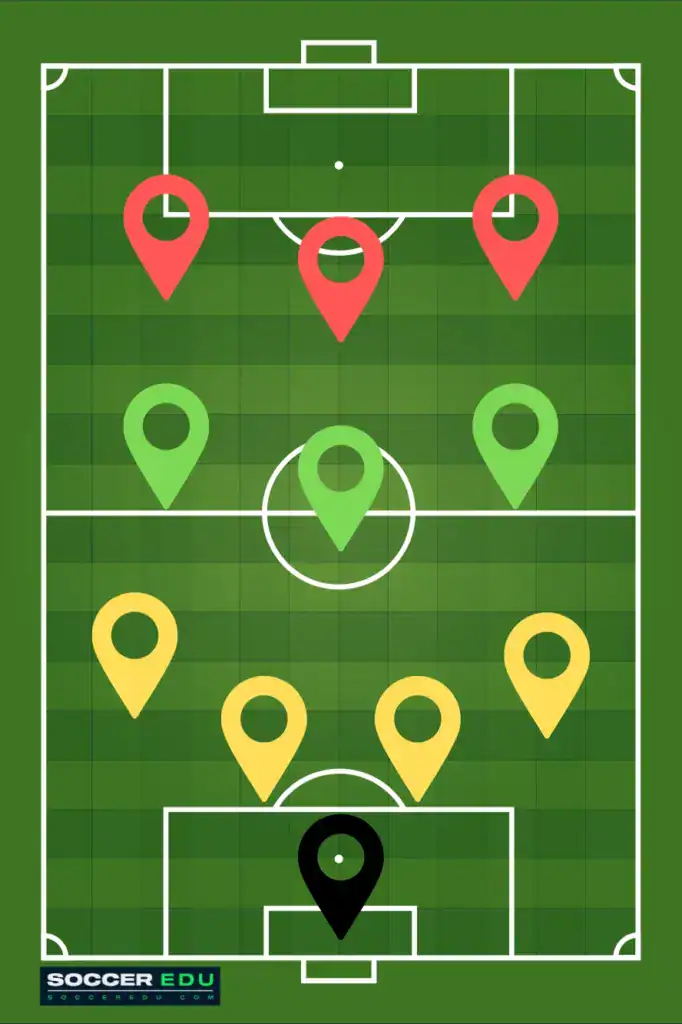
- Why use it? It naturally creates triangles on the field, which helps with passing and possession. It is excellent for pressing high up the field.
- Potential Downside: The lone striker can become isolated if the wingers don’t support quickly, and fullbacks must be extremely fit to cover the wide areas.
The 4-2-3-1: The Flexible Hybrid
This is arguably the most popular formation in professional soccer today. It splits the midfield into two defensive holders and three attacking creators behind a lone striker.
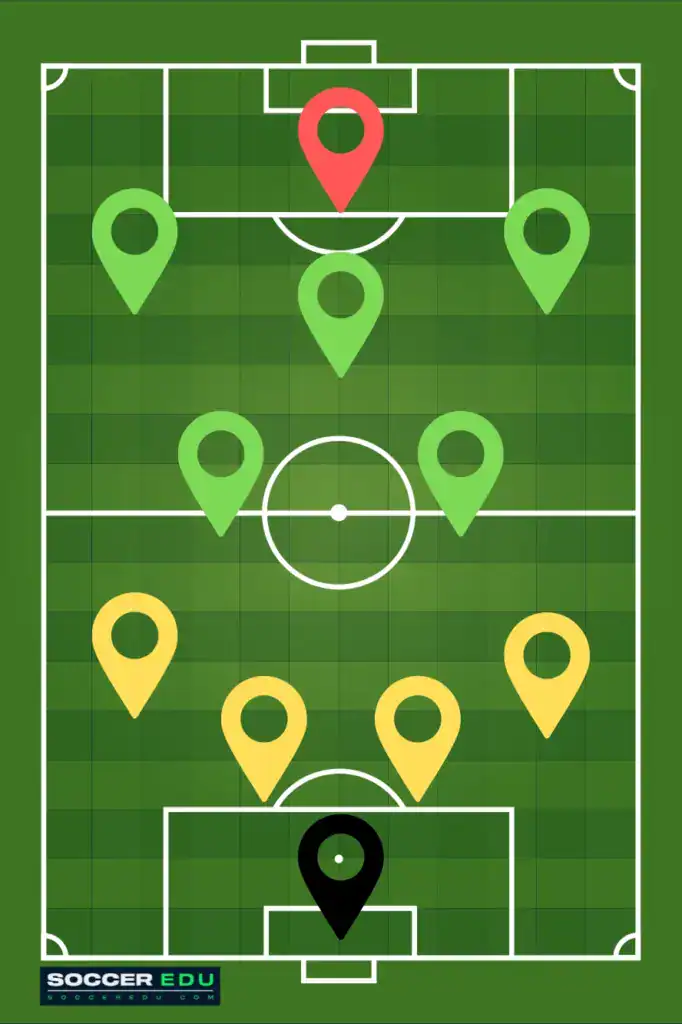
- Why use it? It offers tremendous defensive stability with the “double pivot” (two defensive mids) while allowing four players to attack freely.
- Potential Downside: It requires a very disciplined striker who can hold up the ball alone and a “Number 10” (attacking midfielder) who is creative enough to unlock defenses.
The 3-5-2: The Wing-Back System
This formation removes a defender to add an extra player to the midfield, relying on “wing-backs” to cover the entire sideline.
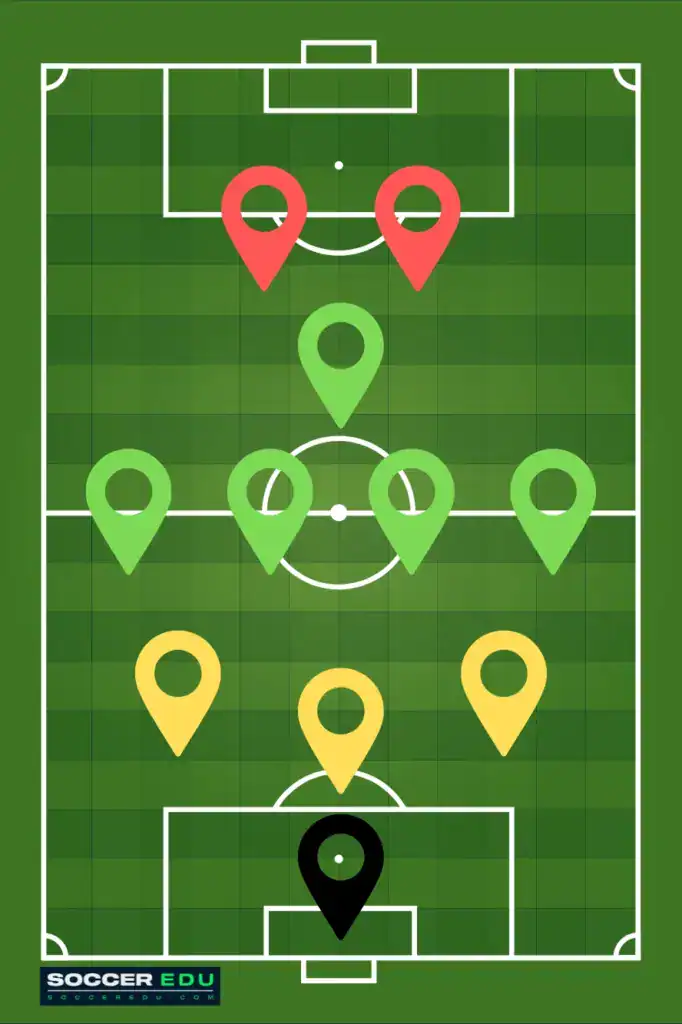
- Why use it? It allows you to dominate the midfield with five players and play with two strikers.
- Potential Downside: It is physically exhausting for the wing-backs. If they get pinned back, the formation flattens into a very defensive 5-3-2.
What is the Best Formation in Soccer?
If you search for “what is the best formation in soccer,” you will find endless debates. The truth is, there is no single best formation.
“One of the most difficult questions is how to make our playing model operational.” – José Mourinho
The “best” formation is simply the one that maximizes your team’s strengths and hides its weaknesses in a specific context.
- For Possession: The 4-3-3 is often considered best because it naturally creates passing angles.
- For Defense: The 4-5-1 or 5-4-1 are often best for “parking the bus” and denying space.
- For Counter-Attacking: The 4-4-2 or 3-5-2 can be deadly by getting the ball forward quickly to two strikers.
A formation is only as good as the players executing it. A disorganized 4-3-3 will lose to a well-drilled 4-4-2 every time.
Our Soccer Tactical Guides
SoccerEdu offers new tactical and strategic soccer guides every week. Here is the complete glossary that allows you to freely navigate our tactical knowledge base:
| Soccer guide | Exercise sheet summary |
|---|---|
| Soccer Game Plan | Overall team strategy |
| Positional Play | Strategic approach |
| Tiki-Taka | Strategic approach |
| Plyometric Training | Boost Explosiveness and Power |
| Counter Pressing | Mastering Instant Ball Recovery After Turnovers |
| Phases of play | Attack, Defense, and Transition Breakdown |
| Soccer Drills | Practice and implementation of strategies |
| 5v5 soccer | Tactical adaptation for 5-a-side soccer |
| 8v8 soccer | Tactical adaptation for 8-a-side soccer |
| Free kick in soccer | The importance of set pieces |
| 4-2-3-1 formation | Exploiting space and team management |
| 3-5-2 formation | Flexibility and defensive cover |
| 5-3-2 formation | Catenaccio and defensive cover |
| 4-3-3 formation | Formation and team dynamics |
| 4-4-2 formation | Balance between defense and attack |
| 4-1-4-1 formation | Defensive solidity and offensive potential |
Formations by Age and Development
It is critical for parents and youth coaches to understand that soccer formations evolve with age. You cannot play a 4-3-3 with a 7-year-old team.
- 7v7 (U9-U10): Common formations include the 2-3-1 or 3-2-1. The focus here is on understanding basic geometry—triangles and diamonds—rather than rigid tactical roles.
- 9v9 (U11-U12): Teams often transition to a 3-2-3 or 3-3-2. This is the bridge to the full game, introducing the concepts of width and midfield support without the complexity of 11 players.
- 11v11 (U13+): This is where “real” formations (4-4-2, 4-3-3) begin. However, at the U13/U14 level, coaches should prioritize formations that teach decision-making over formations that simply win games (e.g., avoiding a sweep-and-clear strategy).
Conclusion
Understanding formations in soccer turns the game from a random series of kicks into a chess match. For a coach, the formation is the blueprint for success. For a player, it is the map that guides their movement.
As you explore specific systems, remember that the formation is a tool, not a rule. The beauty of soccer lies in its fluidity—the way a rigid 4-4-2 can suddenly burst into life, breaking lines and defying structure to create a moment of magic.