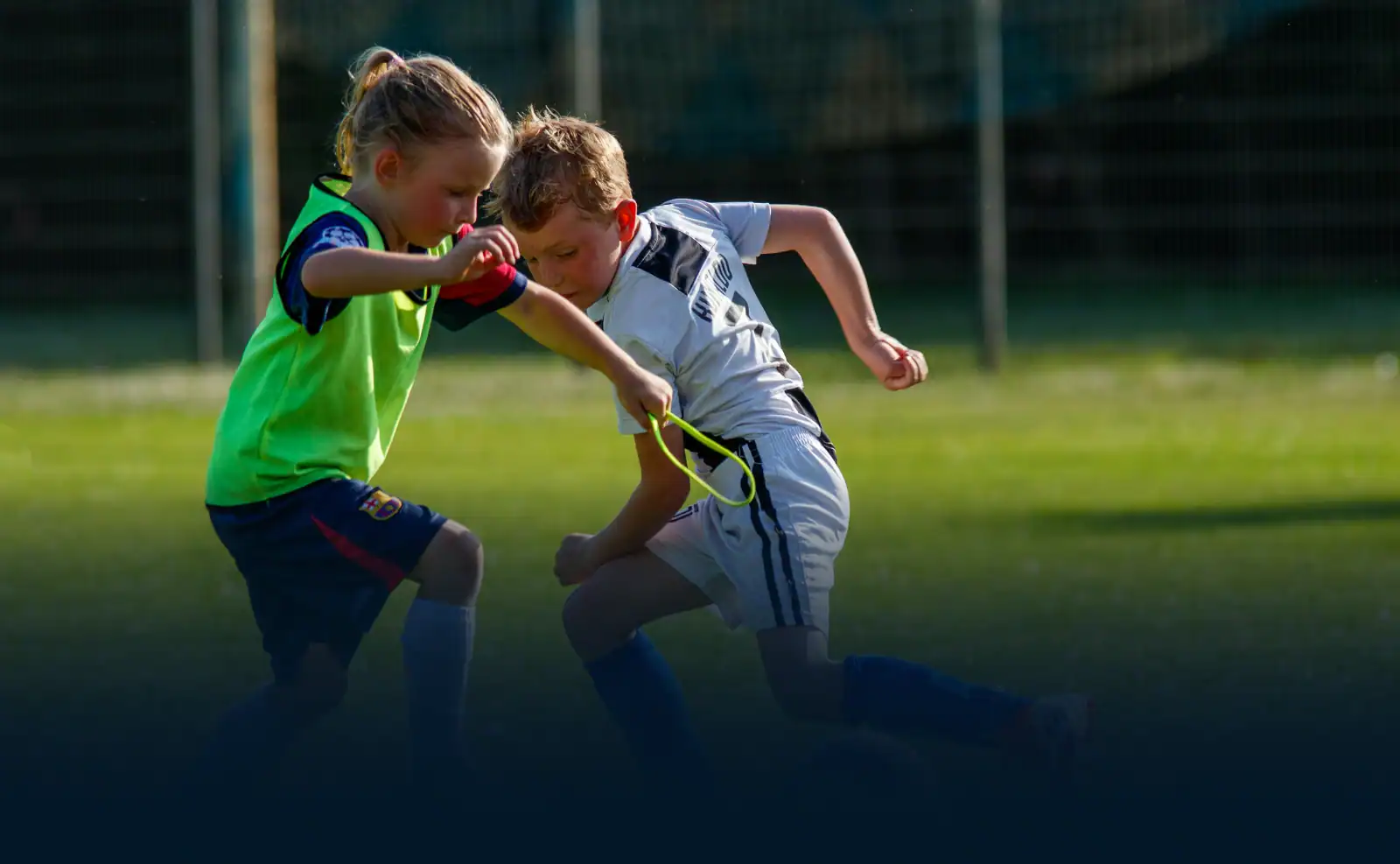
The U6 soccer category represents the very first stage in a young player’s journey.
At this age, children discover the ball, the field, their teammates, and the simple joy of playing.
For coaches as well as parents, it’s a time full of energy, learning, and smiles.
The main goal is motor and social development.
Coaching U6 players means first and foremost creating a kind, dynamic, and fun environment – one where children learn to love soccer before learning how to master it.
What Age Is U6 Soccer?
The U6 category includes children aged five years old, often still in preschool.
At this age, soccer should primarily be a developmental and discovery activity, centered around the fun of playing and getting familiar with the ball.
Training sessions usually last between 45 minutes and 1 hour, with frequent breaks and simple instructions.
The U6 Soccer Environment
At this age, children practice soccer in a flexible, playful environment, often organized around small workshops and fun games.
The U6 and U7 festivals, organized by local leagues, give kids a chance to meet other clubs in a friendly atmosphere, without any focus on the score.
The equipment remains basic: cones, hoops, small goals, lightweight balls, and colorful bibs.
The key is to vary the activities to stimulate curiosity and keep children eager to play.
Developmental Objectives at This Age
The U6 soccer category has three main objectives, aligned with the overall development of a young child.
The focus is primarily on motor skills, enjoyment, and discovery:
1. Developing Overall Motor Skills
At age five, children are building body awareness.
Running, jumping, turning, dribbling, or kicking help them refine coordination and balance.
Each U6 exercise is a chance to move, have fun, and explore physical abilities.
2. Discovering the Ball
Children learn to get familiar with the ball – pushing it with their feet, catching it, rolling it, and protecting it.
These simple gestures form the foundation of technical ability, but they should always remain playful.
The main goal is movement and success, not technique.
3. Encouraging Socialization and Team Spirit
U6 soccer also helps children learn how to be part of a group – waiting their turn, sharing the ball, listening to instructions, congratulating teammates.
These social lessons are just as important as technical skills.
What Is the Role of a U6 Coach?
Being a U6 soccer coach is primarily about guiding and encouraging.
The adult is not a “coach” in the strict sense but a kind and supportive educator.
They must know how to observe, reassure, and praise, while keeping a playful and enthusiastic attitude.
1. Creating a Trusting Environment
Children must feel safe to try new things.
The coach’s smile, tone of voice, and patience are essential.
It’s important to accept moments of distraction or fatigue and gently refocus attention without scolding.
2. Adapting Language
Instructions must be short, concrete, and visual.
Instead of saying “stand on your left side,” the coach might say “go protect your castle” or “follow your ball to the goal.”
Imagination helps children understand and remember.
3. Valuing Every Small Progress
At this age, success is not measured by the accuracy of a shot or the result of a game – it’s about the joy of participating.
A simple word of encouragement or a positive gesture often boosts motivation an confidence.
How to Build a U6 Soccer Session
A U6 session should be short, lively, and focused on enjoyment.
At this age, children learn by moving and repeating simple actions.
The goal is to let them touch the ball as often as possible, in a fun and supportive atmosphere.
A typical session is structured into three stages:
- A physical warm-up, to wake up the body and channel energy.
- A ball-focused phase, to work on dribbling, shooting, or coordination.
- A small group game, where each child can explore freely and learn to cooperate.
Each activity lasts five to ten minutes, with quick transitions and minimal downtime.
The goal is to maintain rhythm and enthusiasm throughout the session.
To go further and discover concrete examples of exercises suited to U6 players, refer to our U6 drills, all designed around a clear objective: learning through play.
You’ll find simple, easy-to-set-up activities focused on developing motor skills, coordination, and ball discovery.
Practical Tips for Coaching the U6 Category
Patience and flexibility are the golden rules.
Coaching a U6 group means learning to work with children’s boundless energy and short attention spans. The coach should create a positive, caring atmosphere where every session is a moment of shared joy.
It’s important to regularly change up games and formats to keep children curious and engaged.
Repetition is essential for learning, but it should never become boring.
It’s better to offer several short, varied activities than one long exercise.
The coach should also focus on success rather than performance.
At this age, children need to feel the satisfaction of “doing something right” – pushing the ball in the right direction, scoring a goal, following an instruction.
Each small success should be encouraged with a kind word or a smile.
Waiting times should be kept to a minimum – children learn by doing, not by watching.
Alternating turns, giving each child a ball, or creating small groups helps keep everyone active.
Communication must remain simple and calm.
There’s no need to raise your voice – a clear tone, kind eye contact, and short instructions are enough to capture attention.
To strengthen the bond between the club and families, it’s also beneficial to involve parents in a positive way – explaining the purpose of the activities without creating performance pressure.
The U6 coach is not there to “create champions”, but to share the first emotions of play, teamwork, and discovery.
U6 Soccer: Learning to Love the Game Above All
Unlike the U19 category, U6 soccer marks the beginning of a beautiful journey. It’s at this age that children experience their first emotions, first achievements, and sometimes their first passions.
For coaches, every session is a chance to pass on the love of the game, respect for others, and the joy of being together on the field.
U6 soccer is not about learning to compete – it’s about learning to share joy. And it’s often in these simple moments, surrounded by laughter and rolling balls, that the future lovers of the game are born.