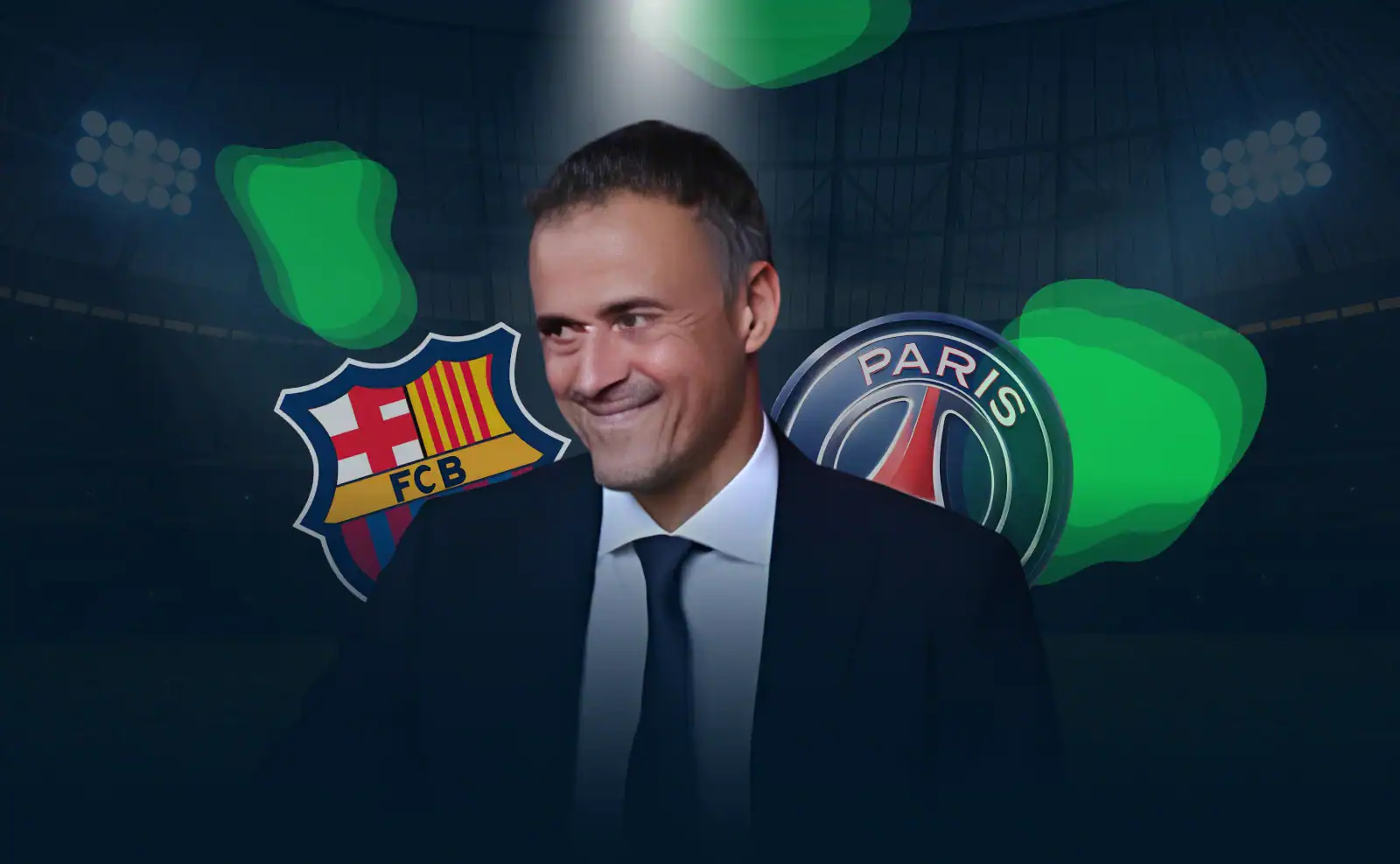
Lionel Messi, Kylian Mbappé, Sergio Busquets, Andrés Iniesta… these are merely some of the world-class talents that Luis Enrique has guided during his distinguished managerial career. Now at the helm of Paris Saint-Germain, Luis Enrique has cemented his status as one of the most accomplished and respected coaches in world soccer, recently crowned the 2025 Ballon d’Or Best Coach winner.
In this comprehensive profile article, we take a look into the story of this exceptional manager, exploring his illustrious playing career, his transformative journey as a tactician, his groundbreaking achievements, and the tactical philosophy that has made him one of the game’s elite managers.
Who Is Luis Enrique?
Luis Enrique Martínez García, born May 8, 1970, in Gijón, Spain, is a former Spanish international soccer player and current elite-level manager. Throughout his career—both as a dynamic, versatile player and as an innovative coach—he has been celebrated for his tactical intelligence, exceptional versatility, natural leadership qualities, and an unwavering competitive spirit that defines everything he touches.
Affectionately nicknamed “Lucho,” Luis Enrique has experienced numerous defining moments throughout both his sporting journey and personal life, moments that have shaped him into the formidable figure he represents today. In the Aliotop video referenced above, you can discover all the pivotal chapters of his remarkable story. Let’s now examine in comprehensive detail his extraordinary path to becoming the head coach of Paris Saint-Germain—and one of soccer’s most decorated managers.
Luis Enrique: His Playing Career
The Beginnings of an icon: Luis Enrique
Today, Luis Enrique is universally recognized for his managerial brilliance, but before orchestrating victories from the touchline, he enjoyed a remarkable 15-year career as a player. Renowned for his exceptional versatility, he excelled in multiple positions—operating as both a midfielder and forward, depending on the tactical requirements of the clubs he represented.
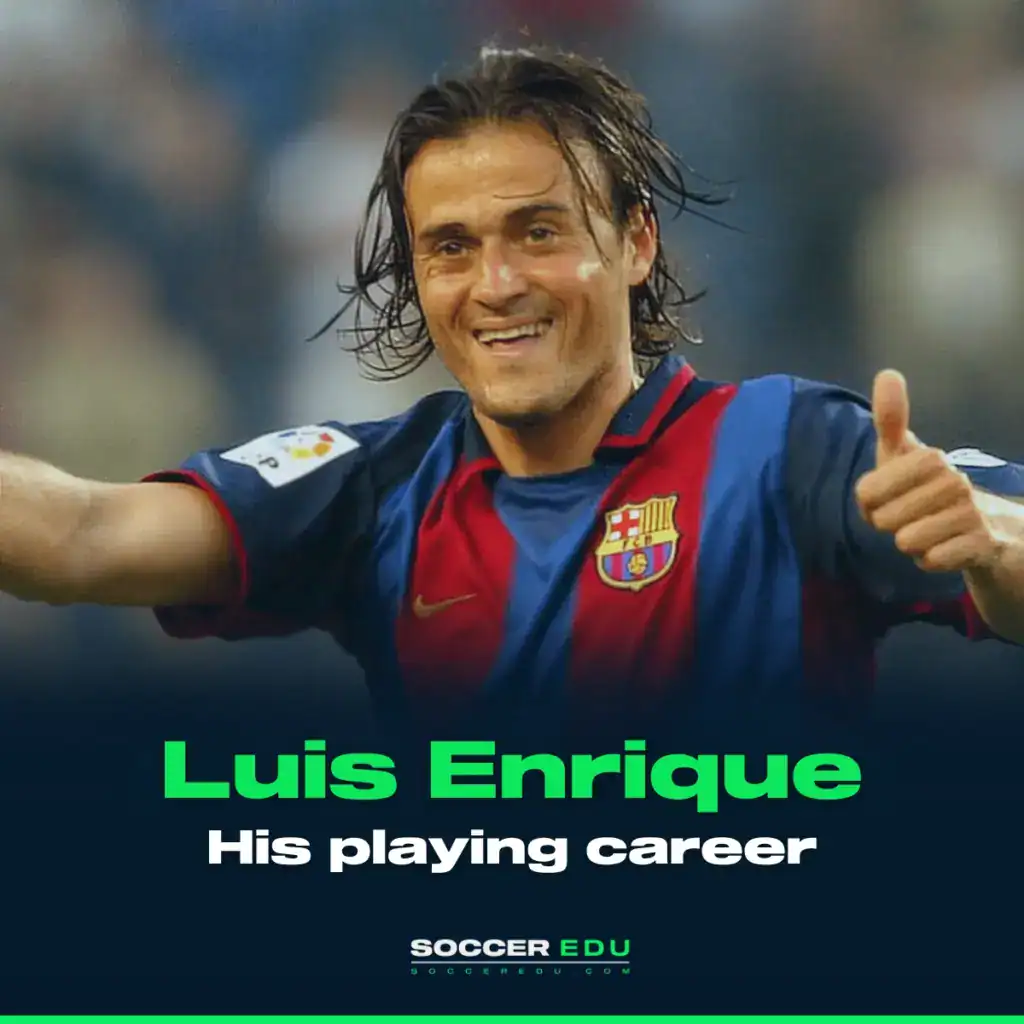
- Start at Sporting Gijón: Luis Enrique embarked on his professional journey at Sporting Gijón, his hometown club in the Asturian coastal city, where he quickly distinguished himself as a prodigious talent with exceptional technical ability and tireless work ethic.
- Transfer to Real Madrid: After catching attention with his performances at Sporting Gijón, Luis Enrique secured a high-profile move to the prestigious Real Madrid in 1991, where he developed into a player of genuine international recognition, winning multiple trophies with Los Blancos.
- Controversial Move to Barcelona: In one of the most controversial transfers in Spanish soccer history, Luis Enrique made the audacious decision to leave Real Madrid and join their fiercest rivals, FC Barcelona, in 1996. This El Clásico transfer initiated the most prolific and successful period of his playing career. As you might imagine, his subsequent returns to the Santiago Bernabéu were met with considerable hostility from the Madrid faithful.
- International Career: In addition to his club success, Luis Enrique proudly represented Spain at the highest international level. He competed for La Roja in several major international tournaments, including three FIFA World Cups (1994, 1998, 2002) and the 1996 UEFA European Championship. His crowning international achievement came at the 1992 Barcelona Olympic Games, where he was instrumental in Spain securing the gold medal—the nation’s first and only Olympic soccer gold medal to date.
Luis Enrique’s international record reflects his importance to Spanish soccer during this transitional era, earning 62 caps and scoring 12 goals for his country between 1991 and 2002.
The Clubs Luis Enrique Played For
Below is a summary table of the clubs where Luis Enrique played, along with his total matches and goals.
| Team | Years | Matches Played | Goals |
|---|---|---|---|
| Sporting Gijón | 1989–1991 | 42 | 17 |
| Real Madrid | 1991–1996 | 213 | 18 |
| FC Barcelona | 1996–2004 | 300 | 108 |
| Spain | 1991–2002 | 68 | 13 |
Luis Enrique’s Coaching Career
The Early Days as a Manager
Luis Enrique began his coaching career by gaining experience with FC Barcelona B, his beloved former club, where he methodically learned the demanding profession of coaching and began developing his distinctive tactical philosophy.
His first major challenge in top-flight management came when he was appointed head coach of AS Roma in Italy’s prestigious Serie A.
- Challenging Start at AS Roma: Despite high expectations, Enrique did not achieve the desired success during his time in Serie A in 2011/12. After just one season, he left the club, having failed to qualify the team for European competition — marking a difficult start to his coaching career.
- Rebuilding at Celta Vigo: Back in Spain, Luis Enrique began to rebuild his reputation during his single but impressive season in charge of Celta Vigo (2013-14). His team performed admirably, finishing ninth in La Liga with 49 points and memorably defeating Real Madrid 2–0, a result that ended Madrid’s title aspirations. This transformative experience at Celta Vigo confirmed Enrique’s emerging credentials as a top-level manager and caught the attention of Barcelona’s sporting directors.
- Return to FC Barcelona: The highlight of Luis Enrique’s coaching career came when he returned to his former club as head coach. Under his leadership, FC Barcelona entered a dominant era, winning a historic treble in his first season — thanks in large part to his attacking trio “MSN”: Lionel Messi, Luis Suárez, and Neymar.
Despite occasional tensions with star players, particularly a well-documented conflict with Messi during his first season, Enrique’s Barcelona would go on to win nine major trophies across three seasons, establishing one of the most dominant periods in the club’s illustrious history.
- Manager of Spain’s National Team: His success with Barcelona earned him the prestigious role of head coach of the Spanish national team in 2018. Despite facing personal tragedy — the illness and death of his daughter — Luis Enrique returned to his post with determination in November 2019, leading the team to new heights in major tournaments before stepping down in 2022.
- Paris Saint-Germain – European Glory: In 2023, Luis Enrique accepted the ambitious challenge of managing Paris Saint-Germain, a club with seemingly unlimited resources yet desperately seeking their elusive first Champions League title. His appointment was warmly embraced by PSG supporters, who hoped he would import his tactical acumen and winning mentality to the Parc des Princes.
In his debut season (2023-24), Enrique secured a domestic treble—Ligue 1, Coupe de France, and Trophée des Champions—while guiding PSG to the Champions League semi-finals. The following season proved even more spectacular: Luis Enrique led Paris Saint-Germain to their long-awaited first-ever Champions League title in May 2025, demolishing Inter Milan 5-0 in the final, while also retaining domestic dominance.
This historic achievement made Luis Enrique only the seventh manager in soccer history to win the Champions League with two different clubs, placing him alongside legends such as Carlo Ancelotti, Pep Guardiola, and José Mourinho. His remarkable achievements earned him the 2025 Ballon d’Or Johan Cruyff Trophy as the world’s best coach.
The Teams Luis Enrique Has Coached
| Team | Years | Matches Managed | Wins | Draws | Losses |
|---|---|---|---|---|---|
| Barcelona B | 2008 – 2011 | 113 | 66 | 22 | 25 |
| AS Roma | July 2011 – May 2012 | 42 | 17 | 9 | 16 |
| Celta Vigo | July 2013 – June 2014 | 40 | 15 | 7 | 18 |
| FC Barcelona | July 2014 – June 2017 | 181 | 138 | 22 | 21 |
| Spain | July 2018 – Mar 2019, Nov 2019 – Dec 2022 | 44 | 24 | 11 | 9 |
| Paris Saint-Germain | 2023– | 111 | 77 | 20 | 14 |
Last updated: June 1, 2025
The Trophies Won by Luis Enrique
Even though Luis Enrique is still active, he has already left a mark on soccer history, winning numerous trophies and distinctions throughout his career — both as a player and as a coach.
Luis Enrique as a Player
- Olympic Gold Medal (1): 1992
- La Liga (2): 1997–98, 1998–99
- Copa del Rey (2): 1997, 1998
- UEFA Cup Winners’ Cup (1): 1997
- UEFA Super Cup (1): 1997
- Spanish Super Cup (2): 1996, 1997
Luis Enrique as a Manager
- La Liga (2): 2014/15, 2015/16
- UEFA Champions League (2): 2014/15, 2024/25
- Copa del Rey (3): 2014/15, 2015/16, 2016/17
- Spanish Super Cup (1): 2016
- UEFA Super Cup (2): 2015, 2025
- FIFA Club World Cup (1): 2015
- Ligue 1 (2): 2023–24, 2024–25
- Trophée des Champions (2): 2023, 2024
- Coupe de France (2): 2023–24, 2024–25
- Ballon d’Or Johan Cruyff Trophy (1): 2025
Luis Enrique and the Champions League: A Historic Double
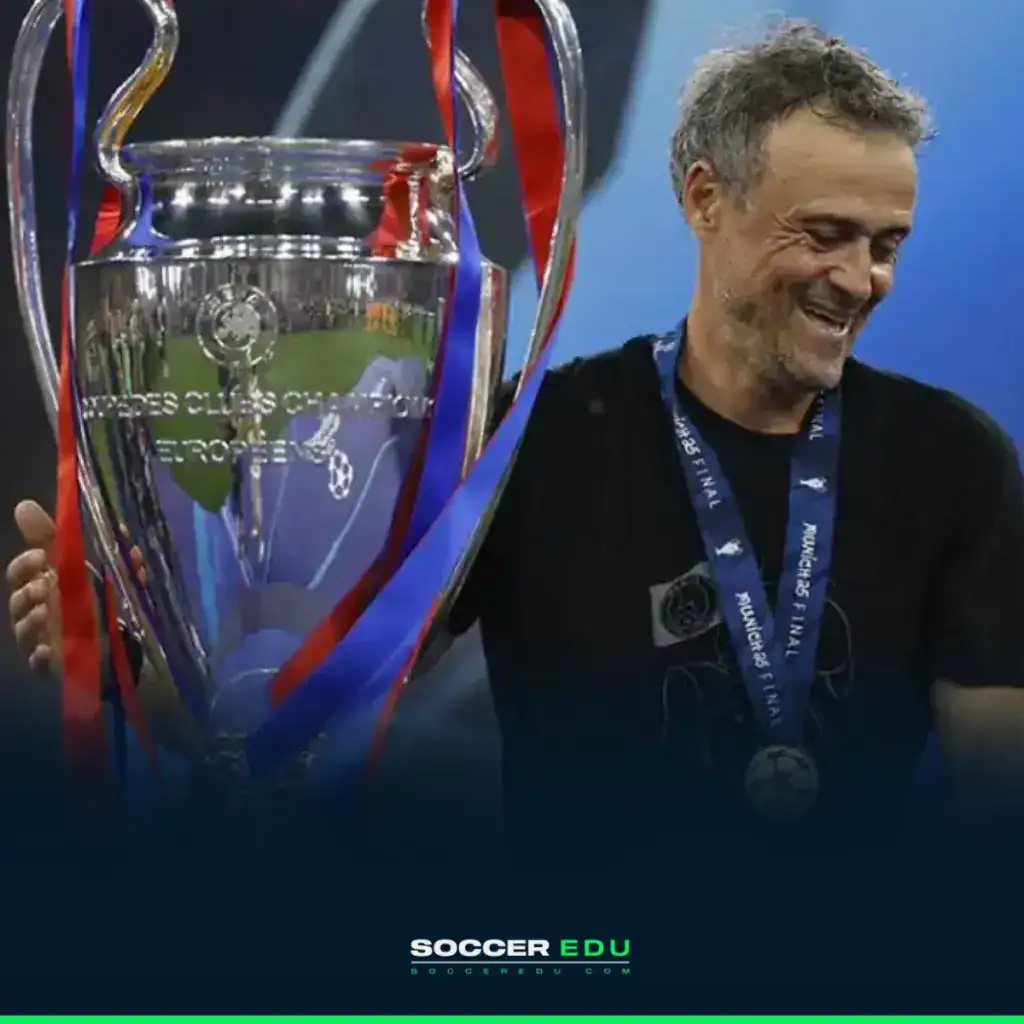
Luis Enrique has entered the record books by winning the UEFA Champions League twice with two different clubs—a feat accomplished by only six other managers in the competition’s history.
After capturing his first European crown with FC Barcelona in 2015, masterminding a devastating attack featuring the legendary trio of Lionel Messi, Luis Suárez, and Neymar, Enrique proved he could replicate that extraordinary success in an entirely different environment. In May 2025, Luis Enrique guided Paris Saint-Germain to their maiden Champions League title with a record-breaking 5-0 demolition of Inter Milan in the final—a historic triumph for the Parisian club that had invested heavily in pursuit of this elusive trophy for over a decade.
This double triumph showcases Enrique’s exceptional tactical flexibility and his remarkable ability to adapt his methods to vastly different contexts and playing styles, solidifying his legacy as one of the finest strategists in contemporary soccer.
Luis Enrique: A Unique and Distinctive Coach
Luis Enrique’s Management Style and Philosophy
Luis Enrique cultivates a distinctive management philosophy built on proximity to his players, fostering an environment where open dialogue and collective responsibility reign supreme. He consistently delivers powerful motivational discourse and demands complete commitment to the team’s objectives above individual interests.
Throughout his managerial career, Enrique has demonstrated an unwavering commitment to team hierarchy, occasionally generating controversy through his firm stance that no individual—regardless of stature—supersedes the collective. This philosophy has manifested in well-documented conflicts with strong personalities, whether with Lionel Messi at FC Barcelona—who once refused to train after being controversially benched—or more recently with Kylian Mbappé at Paris Saint-Germain, where Enrique implemented strategic squad rotation despite Mbappé’s superstar status, particularly as the forward’s contract situation remained unresolved.
“I like being close to my players and listening to what they have to say, what they feel. But the club and team are always above any individual.” — Luis Enrique
Luis Enrique’s Tactics
Enrique’s tactical blueprint remains remarkably consistent across his tenures at Barcelona, Spain, and PSG, characterized by possession-based positional play, relentless high pressing, and meticulously organized attacking structures. He predominantly employs a fluid 4-3-3 formation, though he has demonstrated tactical flexibility when circumstances demand adaptation.
“We have a clear soccering identity—to be the team that dominates possession, that deprives the opponent of the ball and the space to express themselves. Intensity in every phase of the game is non-negotiable.” — Luis Enrique
His teams are built on several core principles:
- Positional Play and Build-Up: Luis Enrique’s sides construct attacks methodically from the back, often adopting a 2-3-5 or 3-2-5 shape in the build-up phase. Full-backs frequently invert into midfield to create numerical superiority, while midfielders push into advanced positions or half-spaces to create overloads in dangerous areas.
- High-Intensity Pressing: Central to Enrique’s philosophy is the implementation of aggressive pressing, often following the famous “six-second rule”—attempting to recover possession within six seconds of losing the ball. This counter-pressing approach, sometimes referred to as “gegenpressing,” aims to suffocate opponents high up the pitch and create immediate goal-scoring opportunities from turnovers.
- Fluid Attacking Movement: Enrique demands constant movement and positional rotation from his attacking players, creating confusion in opposition defensive structures. Wide forwards often drift centrally while midfielders occupy vacated spaces, and overlapping full-backs provide width.
His high defensive line enables rapid vertical transitions—quick, incisive counter-attacks that exploit spaces left by opposing teams. This tactical approach requires exceptional physical conditioning, technical proficiency across all positions, and unwavering mental discipline from his players.
Conclusion: A Modern Coaching Great
From his distinguished achievements as a versatile and accomplished player to his unprecedented success as a tactically innovative manager, Luis Enrique stands as one of the most emblematic and influential figures in contemporary world soccer. His journey—marked by spectacular triumphs, personal tragedy overcome with extraordinary resilience, and an uncompromising commitment to his soccering principles—has established him among the elite coaching fraternity.
As he continues to shape Paris Saint-Germain’s destiny and chase further glory, Luis Enrique’s legacy as a coach who transformed clubs through tactical intelligence, unwavering discipline, and inspirational leadership remains secure. His story serves as a testament to the power of vision, resilience, and an absolute commitment to excellence in the beautiful game.